
how to play:
j!nxed in action
j!nxed
game design | visual design
jan '21 - apr '21
a tabletop game where speed meets mishap.
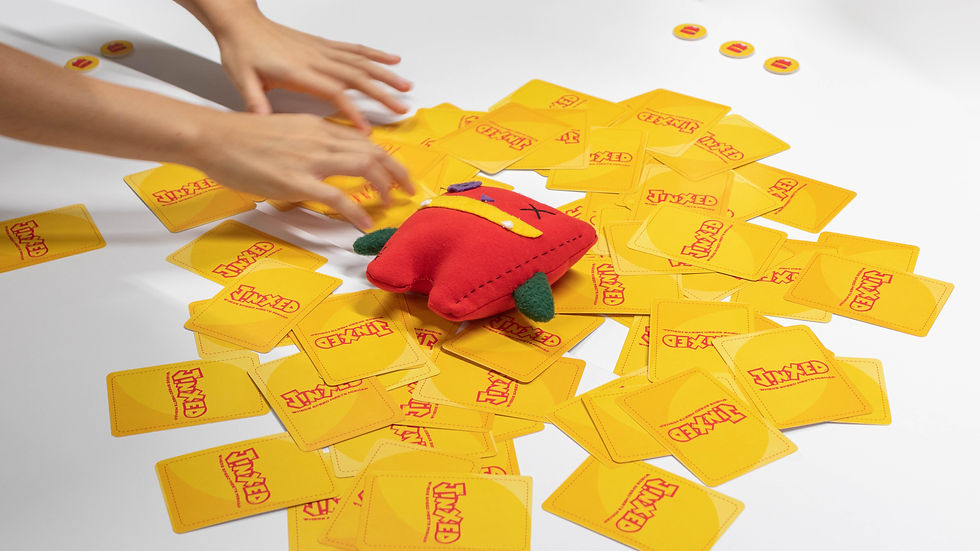
meet the jinxies! these cute & colorful characters are out to test your speed & luck but beware of their little tricks. collect jinxies by matching an identical pair on the table. seems simple at first... but how lucky are you to avoid the risk cards?
collect the most pair of cards to be jinxed-free!
brief
studio project | supervised by brian stone
this project will explore the nuances of interaction design in the context of developing games. these games may be physical, virtual, or a hybrid of the two. they may be developed with an orientation of strategies, quizzes, adventure, fantasy, world-building, trivia, or travel. the main focus however is to understand and design meaningful ‘cause and effect’ relationships and how these dynamics affect human behavior and the perception of competition and fun.
exploration
market research
as an avid lover of tabletop games, i'm always drawn to speed and reaction games. to better understand my competitors, i analyzed this category of games that are currently in the market.


inspiration
most games in the market focus solely on agility. i wanted to add a layer of complexity and bring something fresh to the market. hence, i explored the nuances of unpredictability to bring a higher level of engagement and tension to my game.
develop
conceptualisation
j!nxed started as a game of matching cards. players would take turns to flip open a card. when a pair of identical cards is opened, players would have to be fastest to perform a command to collect it.
by adding elements of unpredictability to such a simple concept that is widely understood by many, it keeps players on their toes while playing.
to test this idea out, a quick prototype was made to validate the vitality of the game concept.

prototyping
once the mechanics of the game was refined, mid-fi prototyping was conducted to visualize the game better. characters were designed to be similar with small variations that are unnoticeable at a quick glance.

user testing
initial tests revealed a couple of flaws;
-
matching identical cards became repetitive after a while
-
the unpredictable elements became easy to spot after a few rounds of concentration and adaptation
-
players found a loophole to constantly perform the command once a new card is open as there weren't any "punishments" that prevented that
hence, i had to ideate on new elements as shown below. multiple rounds of user testing were also conducted to ensure the right amount of unpredictability.


visual identity development
the game identity was built upon the idea of how people would say "jinxed!", "jinxed again!" when they say or do the same thing as another person.
jinxed is often associated with bad luck and misfortune, hence, the moodboard took an evil-looking approach. however, after consultation, a touch of cuteness was added to reduce the strong negative connotations of the word.

initial moodboard

refined moodboard


design developments
deliver
characters
the final set of designs includes 6 sets of characters called jinxies, each with 3 slight variations. the colour palette was inspired by the dynamics of the game to bring out the energetic spirit of j!nxed.


jinxy plushie
the jinxy plushie was handmade with felt and cotton. there were many positive response as to how the plushie adds an interesting element to the game.
fumble tokens
the fumble tokens serve as a punishment for players if the command is performed wrongly or when there's no 2 identical cards.
this resulted from user testing where players constantly performed the command each time a new card is opened as there weren't any consequences for doing so.

risk cards & switch it up! cards
players who draw risk card will have to perform the action.
switch it up! card changes the command that players have to perform, breaking their flow of concentration during the game.


rulebook
rules are strategically arranged with supporting visuals so that users will be able to read it in a glance. information with lower importance such as the contents are placed at the back.
